
Before getting into the details, I should explain why this development matters to tech folks who understand these systems better than most.

Cutting Through the AI Writing Hype
The hype cycle moves fast enough to give you whiplash, so let me slow down before we talk about what’s actually happening here. Romance fiction is the biggest segment of the book market. Publishers and self-published authors are experimenting with AI writing tools to pump out more books and keep up with reader demand.
What I’ve found challenges how most people think about this. The numbers tell part of the story, but only part.
The reality is messier than the headlines suggest. Yes, AI writing tools have gotten better at generating romance stories that make sense. But they work within a complicated ecosystem where human creativity and tech capabilities overlap. The most successful cases use AI as an assistant while keeping humans in the editorial driver’s seat. It’s collaboration, not replacement.
The Current Landscape of AI Romance Writing Tools
Several platforms have emerged as frontrunners in the AI romance writing space. Sudowrite AI writing tool has gained traction among fiction writers for generating solid prose and helping with writer’s block. NovelAI gives you more control over story direction and character development. Newer platforms like Blushing Reader AI story writer focus specifically on romance genre conventions.
These romance-focused platforms consistently outperform general-purpose language models when it comes to understanding genre-specific elements. They get the importance of emotional pacing, tension building, and the particular rhythms that romance readers expect. This specialization extends to recognizing common romance tropes, from enemies-to-lovers dynamics to forced proximity scenarios.
The distinction between general AI writing tools and romance-specific platforms has become increasingly important. A general-purpose AI might produce technically correct prose, but it often misses the subtle emotional beats that make romance fiction work. Dedicated romance AI tools have been trained on genre-specific datasets, so they better replicate the pacing and emotional arcs that define successful romance novels.
Technical Challenges and Limitations
Even with impressive advances, AI romance writers face significant technical hurdles. Character consistency across lengthy narratives is the biggest problem. AI can generate compelling individual scenes, but maintaining character voice, personality traits, and relationship dynamics across a 70,000-word novel? That’s tough. Characters shift personalities mid-story or forget previously established traits and histories.
This consistency problem extends beyond individual characters to world-building and plot coherence. Romance novels often have complex relationship dynamics and emotional development that requires careful tracking across multiple chapters. Current AI systems struggle with the long-term memory needed to maintain these narrative threads effectively.
Another limitation is emotional authenticity. AI can mimic the surface patterns of romantic dialogue and description, but sometimes produces interactions that feel mechanically generated rather than emotionally genuine. The subtle interplay of vulnerability, desire, and emotional growth that defines great romance often eludes current AI capabilities.
Pricing and Professional Workflows
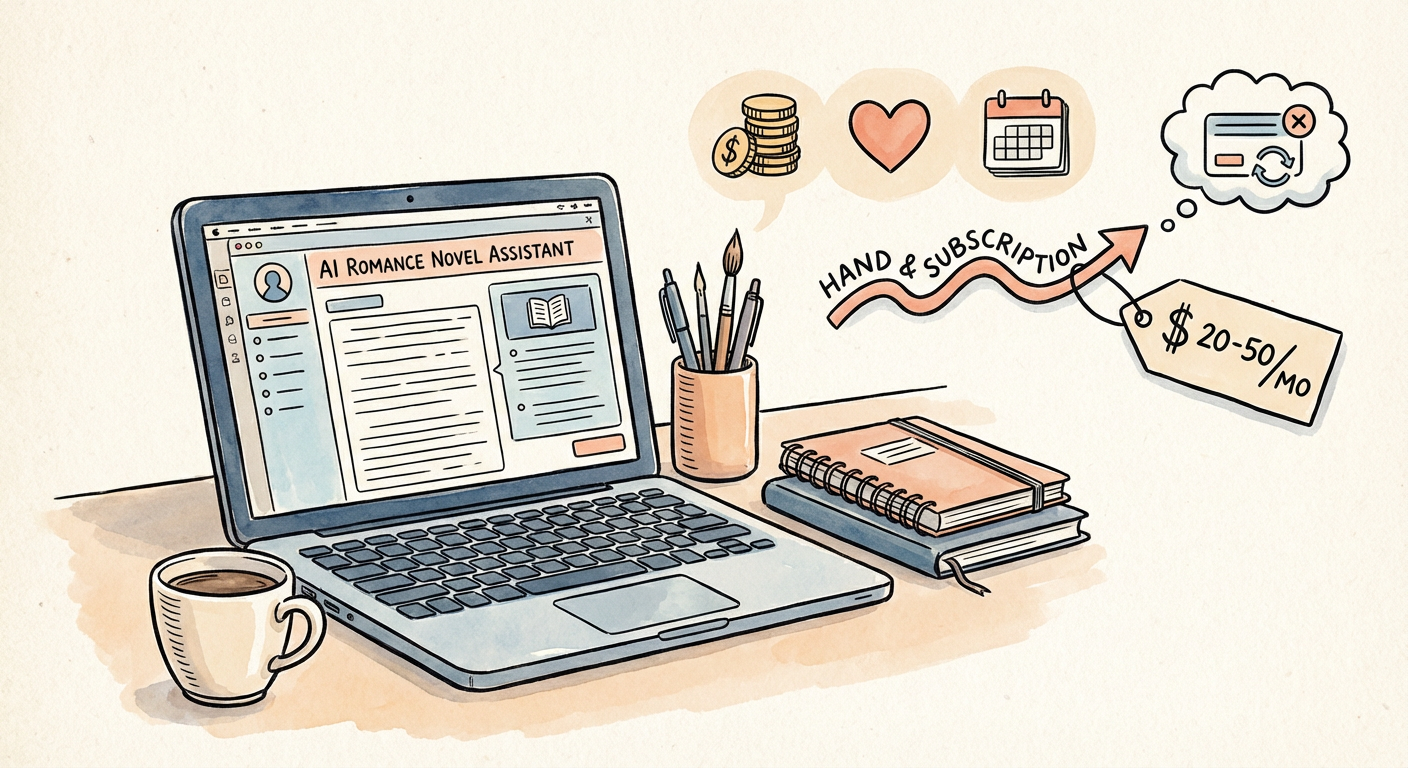
For authors considering AI assistance in their romance writing workflow, pricing has become a major factor. Subscription-based tools designed for serious self-publishing operations typically range from $20 to $50 monthly. These professional-tier services offer features like unlimited generation, advanced customization options, and higher-quality output models.
The economics make sense for authors producing multiple books per year. A $40 monthly subscription can potentially speed up writing schedules and increase publishing frequency, leading to higher overall revenue. Many successful romance authors report using AI tools to generate first drafts or overcome creative blocks, then investing substantial time in human editing and refinement.
The most effective implementations combine AI generation with human creativity and editorial judgment. Authors use AI to explore plot possibilities, generate dialogue options, or develop scene descriptions, but keep creative control over story direction and character development. This hybrid approach maximizes the efficiency gains while preserving the human elements that readers value.
Reader Reception and Quality Comparisons
Here’s what surprised me: reader feedback on AI-assisted romance fiction has been largely positive when the technology is used thoughtfully. Studies of reader responses show that AI-assisted romance novels rate comparably to human-authored category fiction in terms of entertainment value and emotional engagement. With proper human oversight, AI tools can produce commercially viable romance content.
However, this acceptance comes with important caveats. Readers respond most positively to AI-assisted works where human authors maintain creative control and use AI as a collaborative tool rather than a replacement. The most successful AI-assisted romance novels combine instruction-following capabilities with style transfer from author-provided sample text, allowing the AI to match established voice and tone preferences.
The key appears to be transparency and quality control. Readers appreciate knowing when AI assistance has been used, and they expect the same level of editing and quality assurance as traditional publishing. When these standards are met, the origin of the initial draft becomes less relevant than the final reading experience.
As the technology continues evolving, the line between AI-assisted and traditionally written romance fiction will likely blur further. The focus is shifting from whether AI should be used to how it can be integrated most effectively into creative workflows while maintaining the emotional authenticity that romance readers demand.
The specialized AI romance writing category is growing fast. Blushing Reader is an AI erotica novel writer for anyone writing in the romance or erotica space who wants a tool trained on the genre rather than a general-purpose alternative.
If you work in or around this space, the practical implications are worth mapping against your current tooling and roadmap. Try it yourself, the link is above.