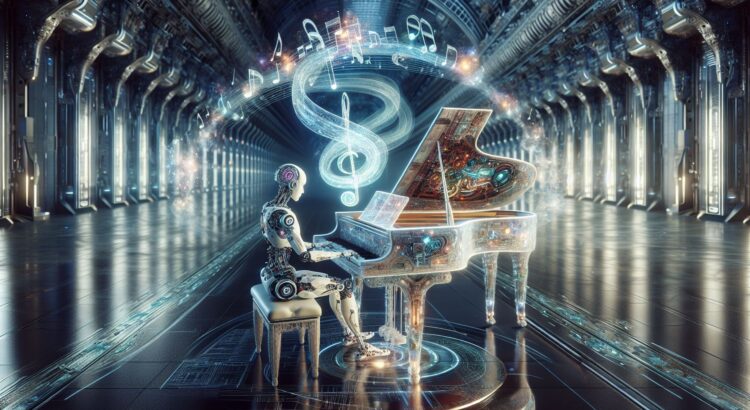
Hey tech enthusiasts and future-seekers! Today, let’s chat about an exciting crossover that’s happening at the intersection of tech and creativity: Artificial Intelligence in the Creative Arts. I’m talking about AI not just taking over grunt work but actually standing on stages with us, paintbrush in hand or piano at the ready. We’re watching ones-and-zeroes meet the messy, unpredictable nature of creativity. Intrigued? Good, because I sure am!
The Rise of Robo-Beethoven
First off, imagine this: a symphony performed by an AI. Now, before you throw your Beethoven records at me, let’s unpack where we are with this. AI has been messing around with music for a while, but the progress I’ve seen in the past few years is astounding. Thanks to advancements in machine learning algorithms, some AI systems can compose music that, at least on the surface, rivals human creativity. Companies like OpenAI have been leading this charge with projects like MuseNet, exploring multi-instrument compositions. Heck, even Sony’s AI has been creating music inspired by Bach!
What’s amazing is how these algorithms learn structures, styles, and patterns from enormous datasets of musical works. They literally “hear” the classics over and over until they get just what makes a piece symphonic or jazzy, and then create something new. I’ve listened to a few AI compositions, and though some come off a bit, let’s say, academic or mechanical, others hit surprising notes of profundity. While I’m not expecting AI to headline Coachella next year, watch out. Your Spotify recommendations might already include some AI hits without you even realizing it.
AI: The Artist’s Assistant
Let’s move from melodies to masterpieces. Artists are toying with AI tools, essentially getting robo-assistants who’re more than just a fancy Photoshop filter. Take Google’s DeepDream, an AI that turns ordinary photos into psychedelic artworks. It’s basically a trippy tool artists can use to see their work in a whole new light, literally.
More sophisticated tools like DALL-E 2, also by OpenAI, are pushing boundaries, turning textual descriptions into vivid, unique images. Artists are seeing these AI creations as a starting point or inspiration for their human-led projects. It reminds me of when artists first got their hands on modern digital tools and graphics tablets. AI feels like the next logical step, rather than a replacement. Imagine having a platform that helps you generate multiple renditions of your work in seconds, each providing a different perspective you might never have conjured on your own.
The Hollywood Dream Machine
Let’s not forget the movie magic! Hollywood’s got AI on its payroll. I’ve heard of AI-generated scripts and storylines, allowing screenwriters to further refine narrative arcs or unearth fresh ideas. Even special effects and visual animations get enhanced with AI, automating tediously repetitive tasks so artists and directors can focus on perfecting their vision.
Though there’s understandable hesitation (trust me, I get it), it echoes the initial fears about CGI. But CGI didn’t terminate directors. It empowered them. Now, AI may end up just another tool in the cinematic arsenal, offering creative minds new clay to mold without replacing the storyteller.
Challenges & Ethical Debates
Now, let’s get real for a sec. This technology isn’t without its hiccups and head scratchers. Creativity is fundamentally human. It’s an emotional and profound experience. Can algorithms dig deep enough to create art with heart? There’s also the question of originality. Some argue AI just rehashes what’s fed to it, devoid of genuine innovation.
Remember when AI-generated artwork of a fictitious person won a photography contest recently? That stirred a pot of “what does it mean to be real?” debates. The moral lines are still pretty wavy around copyrights and ethics. Who owns AI-generated art? Is it just a tool or does it earn co-creator status?
Looking Ahead: An AI-Creative Collaboration
Okay, I promised a techno-utopian vibe, right? Here’s my hopeful take: instead of viewing AI as an adversary, let’s see it as a collaborator in our artistic endeavors. Imagine virtual museums with art exhibits where AI and humans have harmoniously painted together, or symphonies where melodies from AI are beautifully intertwined with human improvisation.
The infinite possibilities with AR and VR intertwine with AI to create immersive art experiences like never before. You’ll dive into digital masterpieces, not just view them but journey through them. Picture an “Alice in Wonderland” experience, where your Cheshire Cat guides are AI-generated, yes, but their ability to adapt to your choices makes each visit refreshingly unique.
AI isn’t here to replace the Picassos, Monets, or Beatles of the world. Instead, it’s a new instrument to be wielded, offering new forms of expression for those boundless human imaginations out there.
So, are we ready for this AI-creative revolution? Personally, I can’t wait to see what these electronic buddies help bring to life next. Keep your eyes and ears open, friends. It’s gonna be a wild and beautiful ride!