When Your Build Pipeline Becomes Your Worst Enemy
It was 2:47 AM on a Tuesday when our monitoring started screaming. Not the usual “disk space low” whimper, but the full-throated wail that makes your stomach drop before your brain even processes what’s happening. Our main application was making outbound connections to IP addresses in Eastern Europe. Lots of them. The kind of behavior that makes security teams reach for the whiskey bottle.
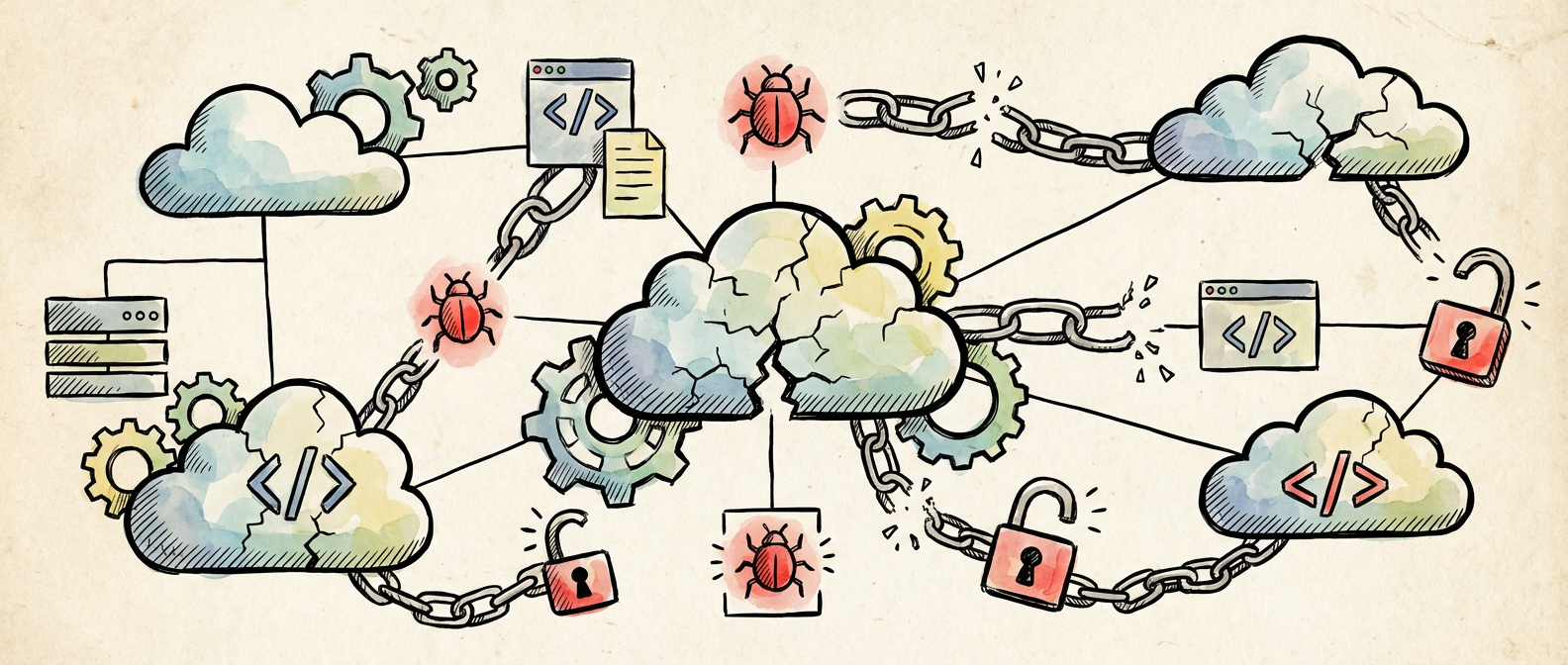
What we discovered over the next eighteen hours changed how I think about modern software stacks forever. The vulnerability wasn’t in our code, our infrastructure, or even our third-party dependencies. It was hiding three layers deep in our build pipeline, masquerading as a helpful development tool that had been quietly stealing environment variables for three months. The attack was so elegant it was almost beautiful, if you ignore the part where it nearly destroyed our startup.

The Modern Stack: A House of Cards Built on Trust
Today’s applications are incredible exercises in composition. A typical microservice pulls in dozens of npm packages, runs in a Docker container built from a base image with hundreds of system libraries, orchestrated by Kubernetes, monitored by agents that themselves have dependencies, all deployed through CI/CD pipelines that execute code from multiple repositories. Each component trusts the next in this complex web of assumptions that would make a medieval theologian weep with envy.
The problem isn’t that we have dependencies. The problem is that we’ve built a culture where adding a new dependency is easier than writing ten lines of code. Need to left-pad a string? There’s a package for that. Want to check if a number is odd? Someone’s published an npm module that does exactly that, and somehow it has 50,000 weekly downloads. We’ve optimized for developer velocity at the expense of understanding what we’re actually running in production.
This isn’t just philosophical hand-wringing. In our case, the compromised package was buried four levels deep in our development dependencies. It wasn’t even running in production, just during our build process. But it had access to everything: AWS credentials, database connection strings, API keys for every service we used. The attacker didn’t need to compromise our production infrastructure when they could just wait for our CI system to hand them the keys to the kingdom.
The Sleight of Hand: How Supply Chain Attacks Really Work
The traditional security model assumes a perimeter. You have trusted code inside the walls and untrusted input from outside. Firewalls, input validation, authentication, authorization. All great tools for fighting the last war. Supply chain attacks laugh at your perimeter because the threat is already inside, invited in through your own front door and given root access to your most sensitive systems.
The package that bit us was called “dev-utils-helper” — generic enough to fly under the radar, useful enough to get included in other packages. Its maintainer had been building credibility for two years, publishing legitimate tools and building a reputation in the community. Then one day, version 2.1.7 included a few extra lines of code that would make a network request during installation, but only if certain environment variables were present. Variables that just happened to match the naming conventions used by popular CI systems.
The genius of it was the timing. The malicious code only activated during package installation, not runtime. It looked for environment variables that indicated it was running in a build environment, then quietly collected whatever secrets it could find and sent them home. No runtime performance impact, no suspicious network traffic from production servers, no obvious signs of compromise. Just a build process that took an extra 200 milliseconds while our entire infrastructure got pwned.
Detection: Finding Needles in Increasingly Large Haystacks
We got lucky. Our network monitoring caught the outbound connections from the CI system because someone had the foresight to treat build infrastructure as potentially hostile. Most organizations don’t. They secure production environments and treat development and build systems as trusted internal resources. That’s exactly backwards in a world where your development tools might be more dangerous than your production traffic.
The detection problem is genuinely hard. Static analysis can catch obvious malware, but sophisticated attacks use techniques that look identical to legitimate functionality. Dynamic analysis helps, but it’s resource-intensive and easy to evade with conditional logic that only triggers in specific environments. Dependency scanning tools are useful for known vulnerabilities, but they’re always playing catch-up with novel attacks.
What actually works is assuming breach from the beginning. Segment your build environments. Limit the credentials available during builds to exactly what’s needed, not everything that’s convenient. Monitor network traffic from systems that shouldn’t be making external connections. Use temporary credentials that expire quickly. None of this prevents supply chain attacks, but it limits the damage when they succeed.
The most effective change we made was implementing a “staging secrets” system where our CI pipeline gets access to non-production credentials that let us deploy to staging environments but can’t touch production data. Real production deployments happen through a separate, more locked-down process that doesn’t have the same dependency attack surface. It’s less convenient, but convenience is what got us into trouble in the first place.
Building Resilience in an Untrustworthy World
The uncomfortable truth is that perfect security is incompatible with modern development practices. We’re not going back to writing everything from scratch in assembly language, and we shouldn’t. The productivity gains from reusable components and rapid iteration are real and valuable. But we need to design systems that can function safely even when components are compromised.
This means embracing paranoia as a design principle. Every component should have limited access to exactly what it needs and nothing more. Build systems should run in isolated environments with minimal credentials. Production deployments should require human approval and cryptographic signatures. Monitoring should assume that anything generating logs might be lying.
The other piece is cultural. We need to stop treating dependency management as a solved problem and start treating it as an ongoing security practice. That means actually reading the code in packages you depend on, especially for anything that runs with elevated privileges. It means pinning versions and testing updates in isolated environments before deploying them. It means having a plan for when (not if) a dependency gets compromised.
Six months later, we’re still finding edge cases in our new security model. It’s messier and sometimes slower than the old way of doing things. But I sleep better at night knowing that when the next clever attack comes along, we might actually detect it before it completely ruins our day. If you’ve got war stories from your own encounters with supply chain security, I’d love to hear them. The only way we’re going to stay ahead of this problem is by sharing what we’ve learned the hard way.