
The Morning After the AI Revolution
Three months ago, our engineering team got swept up in the latest wave of AI coding assistants, with Meta’s Code Llama 3 promising to change everything about how we write software. The benchmarks looked impressive, the demos were slick, and management was asking pointed questions about developer productivity. So we dove in headfirst, expecting our junior developers to suddenly write senior-level code and our seniors to become unstoppable coding machines.

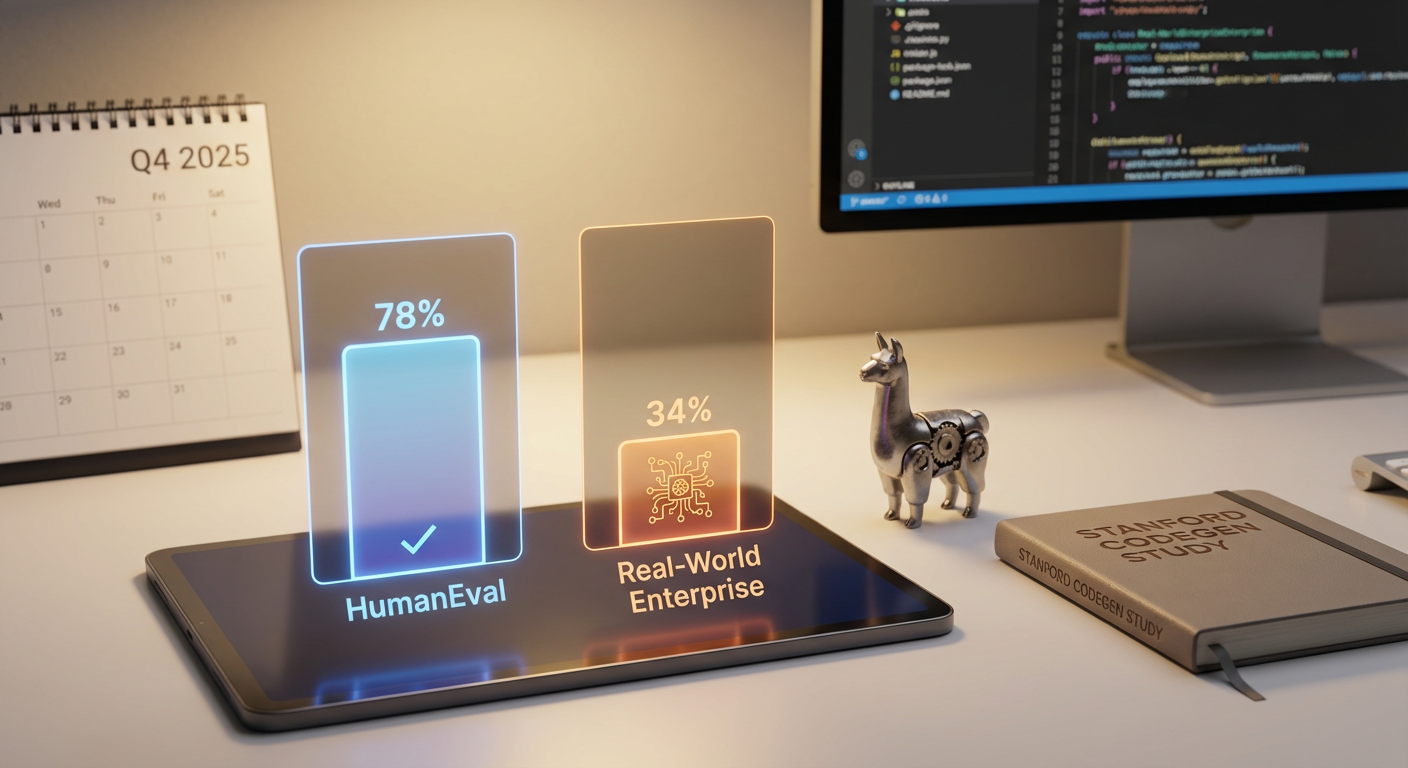
What we discovered instead was a sobering lesson in the difference between controlled environments and the chaotic reality of enterprise software development. While Code Llama 3 hit 78% accuracy on HumanEval benchmarks, the Stanford CodeGen Research Study showed a harsh truth: that same model managed only 34% accuracy when unleashed on real-world enterprise codebases. The gap between academic benchmarks and production reality turned out to be a chasm wide enough to swallow entire sprint commitments.
The honeymoon period was brief but intoxicating. For the first few weeks, our developers marveled at the AI’s ability to generate boilerplate code, suggest function implementations, and even help with documentation. The productivity gains felt real. Then we started hitting edge cases, legacy system integrations, and the kind of gnarly business logic that makes you question your career choices at 2 AM.
When the Magic Wears Off
The disillusionment started small. A suggested function that looked perfect but failed to handle our specific data validation requirements. An elegant algorithm that completely ignored our established error handling patterns. Database queries that worked in isolation but created deadlocks when integrated with our existing transaction management. Each incident required more debugging time than writing the original code would have taken.
This pattern isn’t unique to our team. The GitHub’s 2025 Developer Experience Report revealed that Copilot usage among teams with five or more years of experience dropped by 23% after the initial six-month adoption period. The veterans figured out what we learned the hard way: AI-generated code often creates more problems than it solves when you’re dealing with complex, interconnected systems.
The most experienced developers on our team became increasingly selective about when and how they used AI assistance. They learned to treat it like sophisticated autocomplete rather than a coding partner, useful for generating test cases or exploring API documentation but unreliable for anything requiring deep system knowledge or nuanced business logic understanding.
Meanwhile, our junior developers fell into a different trap. They became overly dependent on AI suggestions, losing opportunities to develop critical thinking skills about code architecture and design patterns. When the AI produced plausible-looking but fundamentally flawed solutions, they lacked the experience to spot the problems before committing to version control.
The Debug Tax Nobody Talks About
Stack Overflow’s latest survey dropped a statistic that made our entire engineering leadership team pause: 67% of developers now spend more time debugging AI-generated code than writing original solutions for complex business logic. This matches our experience perfectly. What should have been productivity multipliers became productivity drains, especially when dealing with the complex requirements that define enterprise software.
The debugging challenge with AI-generated code is particularly tricky because the code often looks correct at first glance. It follows proper syntax, uses reasonable variable names, and implements what appears to be sound logic. The problems emerge during integration, under load, or when edge cases expose assumptions the AI made about data structures, user behavior, or system constraints.
We tracked our debugging time carefully for eight weeks. For straightforward implementations like CRUD operations or simple API integrations, AI assistance provided genuine time savings. But for anything involving complex business rules, multi-service orchestration, or performance-critical operations, the debug-to-development ratio inverted. We spent more time understanding and fixing AI suggestions than we would have invested in thoughtful, deliberate implementation from scratch.
The security implications added another layer of complexity. Anthropic’s Claude 3.5 Sonnet, during beta testing at major enterprises, showed a 45% false positive rate when suggesting security fixes in production environments. These weren’t minor oversights but fundamental misunderstandings of authentication flows, data validation requirements, and authorization patterns specific to each organization’s security model.
The Human Element That AI Still Missing
The most telling metric came from Microsoft’s internal DevOps analysis: OpenAI’s GPT-4 Turbo code generation requires an average of 2.3 human review cycles before reaching deployment readiness. This isn’t a failure of the technology so much as a recognition that software development involves far more than translating requirements into syntactically correct code.
Senior developers bring context that no AI model currently possesses. They understand the historical decisions that shaped the current architecture, the performance characteristics of different implementation approaches, and the subtle interdependencies that make seemingly simple changes ripple through multiple system components. They know which shortcuts will create technical debt and which optimizations will actually matter in production.
More importantly, experienced developers excel at asking the right questions before writing any code at all. They challenge requirements, propose alternative approaches, and identify potential issues that requirements documents never capture. AI coding assistants, no matter how sophisticated, remain fundamentally reactive tools that generate solutions to problems as stated rather than questioning whether those problems are worth solving in the first place.
The nuanced understanding of trade-offs is another irreplaceable human capability. Should this function prioritize memory efficiency or execution speed? How should error conditions bubble up through the application layers? What level of abstraction helps future maintainability without over-engineering current requirements? These decisions require experience, judgment, and deep understanding of both technical and business contexts that extend far beyond pattern recognition and code generation.
Finding the Right Partnership Model
After months of experimentation, we’ve settled into a more pragmatic relationship with AI coding tools. They excel as research assistants, helping explore unfamiliar APIs or generating comprehensive test scenarios. They’re invaluable for documentation tasks and can quickly prototype multiple implementation approaches for comparison. But they remain tools that amplify human capabilities rather than replace human judgment.
The most successful AI integration happened when our senior developers used these tools strategically rather than reflexively. They used AI for rapid exploration of solution spaces, then applied their experience and domain knowledge to select and refine the most promising approaches. This combination of AI-powered generation and human-guided curation proved far more effective than either pure AI assistance or traditional manual development.
We also discovered that AI coding tools work best within well-established architectural patterns and coding standards. When the surrounding codebase provides clear examples and consistent conventions, AI suggestions align more closely with project requirements and team expectations. The tools struggle most in greenfield projects or legacy systems where patterns are inconsistent and context is king.
The reality is that Meta’s Code Llama 3, like all current AI coding assistants, is an impressive but fundamentally limited tool in the software development toolkit. It can accelerate certain types of work and provide valuable assistance with routine tasks, but it cannot replace the strategic thinking, contextual knowledge, and hard-earned wisdom that define truly senior-level development work. The future likely belongs to developers who learn to wield these tools effectively rather than those who expect to be replaced by them.