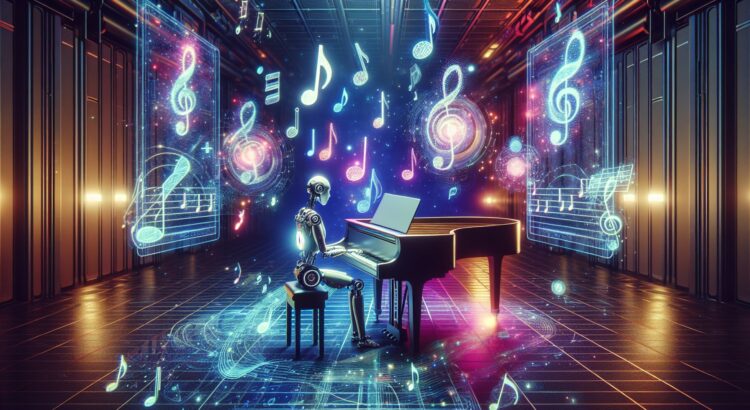
Hey tech aficionados, gathering around the virtual campfire today for an electrifying topic that’s as futuristic as it is intriguing: artificial intelligence in the creative arts. Yes, the very concept of letting machines wield the paintbrush or strum a guitar sounds like a sci-fi wonderland we’re stepping into. It’s like handing Van Gogh’s brush to a hyper-smart calculator—will it recreate Starry Night or draw an uninspiring flowchart? Let’s jump into this fascinating symphony being composed by AI and see what all the fuss is about.
The Intersection of Bytes and Brushes
Artists or Artifacts?
In the past few years, AI has been staging a quiet takeover in the world of fine arts, slowly creeping into domains like painting, music, and literature. I remember queuing up in a virtual gallery during the 2020 lockdown days, sipping coffee as I browsed through AI-generated artworks that looked as profound as any human masterpiece. It left me both mesmerized and slightly anxious. Can these algorithms truly achieve what our expressive hearts can? Are we looking at artists or artifacts?
What’s exhilarating, and frankly terrifying, is how far we’ve come. Neural networks and deep learning algorithms are now churning out creations that can go head-to-head with human work. Companies like DeepArt and Artbreeder have become household names for their ability to generate striking visual pieces by crunching data and recognizing patterns beyond our wildest dreams.
Algorithmic Beats and Harmonies
Music is yet another field where AI has been making its mark. Platforms like AIVA (Artificial Intelligence Virtual Artist) can now produce original compositions that aren’t just catchy but can evoke an emotional depth you’d usually associate with a seasoned composer. Think about the last epic score you heard in a movie; there’s a good chance that, soon, an algorithmic Beethoven might be behind it.
A few years back, I was at a music festival where one of the acts was a DJ who exclusively played AI-generated tunes. The crowd was rockin’—and it was a thought-provoking moment to realize that zero human hands had crafted those beats. It was as if the DJ was collaborating with code!
Pioneering Platforms and Visionaries
The Rise of Creative Coders
What I love about emerging technologies is the wealth of opportunity they present. AI in the creative arts is no exception. Innovators like Picasso and da Vinci are being reincarnated in the form of data scientists and computer engineers who now carry the torch of creativity. These modern-day Michelangelos are coding symphonies of kaleidoscopic possibilities.
Platforms sit right at the center of this revolution. RunwayML, OpenAI’s DALL-E, and Google’s Magenta project empower artists with AI tools that expand their creative horizons, allowing for hybrid forms of art that are neither purely human nor machine. It’s a marriage of the cerebral and artistic prowess of the human mind and computational genius.
When Machines Meet Muses
Let’s not forget the pioneers sparking this evolution. Personalities like Sophia Crespo have used AI to blend elements of art and science, producing artifacts that are surreal and organic, challenging, and enthralling. They’re exploring new territories where the muses reside alongside powerful processors.
I had a chance meeting with a tech artist last year, Sarah, who was using AI to create 3D sculptures. Watching her demonstrate how she could input different parameters and watch the computer sculpt a digital piece in real-time was like seeing magic unravel. Machines, muses, and magic, folks!
Potential Roadblocks on the Path of Progress
Creativity Without Emotion?
As we stand on this thrilling precipice, let’s anchor back to some tough questions. Can machines ever fundamentally “understand” art? Can they create without consciousness? These questions linger like shadows, dimming the glowing optimism just a bit.
After all, art has historically been an emotional catharsis for humanity, and AI lacks this very essence. For now, it relies on massive datasets and mimics patterns. The semantic depth, the layers of meaning behind a piece reducing its significance to a collection of metrics—it’s an ethical puzzle we must navigate thoughtfully.
Augmentation or Assimilation?
The question on everyone’s mind, including mine: Are we augmenting ourselves or being slowly replaced by silicon? Thoughtful use of AI can definitely complement human creativity, pushing our capabilities beyond their current limits. But let it run wild unchecked, and we might find ourselves in a homogenized artistic landscape—a strange future where originality becomes an algorithmic assembly line.
Wrapping: The Overture to an Age of Creativity
So folks, where do we go from here? Are we humming the prelude to a brave new world where AI becomes the demigod of the creative arts? Or is caution going to be the name of the game, balancing unrestrained innovation with humane consideration?
In this era of rapid technological change, one thing’s for certain—AI is here to stay, and it’s ready to tussle, tango, and create alongside us. It’s going to rewrite the narrative in ways we haven’t even imagined yet. And who knows, perhaps my next blog post will be co-authored by an AI scribe—let’s hope it’s as excited to explore the future as I am!
Here’s to symphonies yet unwritten and canvases yet untarnished, ready to absorb the colors of creativity, be it human or machine-dreamed. Cheers!