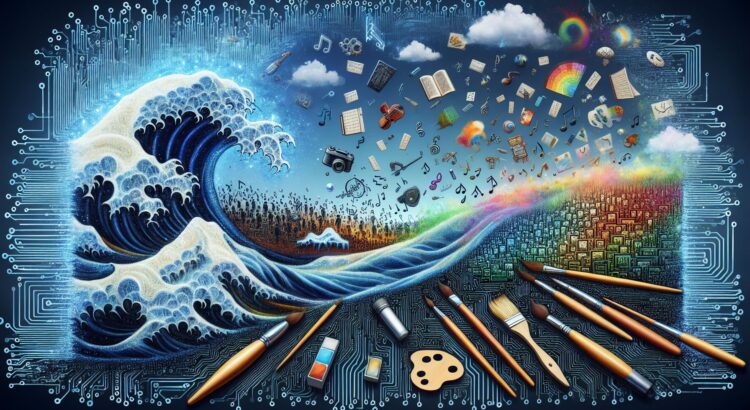
Ah, the sweet symphony of technology and creativity—it’s a duet we’ve been excited about for decades, and now, it’s finally hitting the high notes. I’m always fascinated by how artificial intelligence is elbowing its way into every nook and cranny of our lives, but recently, it’s the AI’s foray into the creative arts that’s got me all kinds of excited. Imagine: machines that can paint a portrait, compose a sonnet, or even design an entire fashion line. It’s like the world’s coolest art show, and everyone’s invited!
When AI Paints the Town Red
Let’s start with the paintbrush, one of humanity’s oldest tools for storytelling. AI has recently become quite the painter, and it’s doing more than just staying inside the lines. You might remember when an AI-generated piece called “Portrait of Edmond de Belamy” sold for a staggering $432,500 at auction in 2018. Since then, AI painters have come a long way. These aren’t just copies of existing works but original pieces created by algorithms trained to understand texture, color, and style.
In my humble opinion, the real excitement is seeing what AI artists can create in collaboration with humans. Google DeepDream opened doors a while back, but programs like DALL-E 2 are now taking it up several notches. Artists use these tools not to replace their creativity but to expand it, inspire new directions, and explore uncharted territory. It’s like having a digital muse with endless patience and infinite imagination.
From Verses to Versatility: AI Poets
Switching gears to poetry, AI has been dipping its toes, or perhaps its processors, into the world of verse. I remember testing out GPT-3 to see if it could handle a haiku, and let’s just say, it wasn’t half bad! But the new models tackle sonnets and free verse with a creativity that’s starting to give the Romantics a run for their money.
Sure, right now, the poets among us might be safe. After all, there’s something uniquely human about raw emotion. However, AI poets have started to employ emotional intelligence, picking up cues from vast libraries of literature to create beautifully poignant prose. Poets who can turn data into prose, there’s an art form for the Fourth Industrial Revolution, if there ever was one.
Fashioning the Future
Let’s not forget the fashion industry, where AI is strutting its stuff on virtual catwalks. Fashion houses use AI to predict trends, optimize supply chains, and even design clothing. Imagine making a custom-fitted jacket in minutes with AI assistance or trying on a dozen outfits without leaving your bedroom, thanks to augmented reality and machine learning.
I see a future where AI doesn’t just spot trends but sets them. Digital garments created by AI might start influencing how physical clothes are made and worn. It’s personalized fashion for the masses, thanks to data-driven analyses that can adjust to cultural shifts and personal preferences faster than you can say “haute couture.”
A Brush of Ethics and an Eye for the Future
Of course, it wouldn’t be a proper tech conversation without jumping into the ethical pool. As with any powerful tech, AI in creative arts raises questions, like “Who owns an AI-generated piece?” and “What happens to human artists?” While there’s no definitive answer, this growing field pushes us to rethink the very nature of creativity and ownership.
I wouldn’t be surprised if future creative teams are made up of both humans and AIs, working in harmony to push the boundaries of art. This could mean more opportunities, not fewer, for artists willing to embrace AI as a tool, just like a new brush or musical instrument.
Wrapping Up: The Art of the Possible
Honestly, I’m as giddy as a kid in a candy store watching AI remix what it means to be creative. Far from being the robots from dystopian fears, these AI artists are more like curious apprentices, learning from us and presenting new visions.
AI in the creative arts isn’t just about creating pretty pictures or catchy tunes. It’s reshaping how we view art, technology, and human ingenuity. We’re not just spectators but participants in this wonderful and weird process. Let’s grab a paintbrush, or, heck, a data set, and create something magical together. After all, art isn’t just meant to be seen but to be made by every one of us.