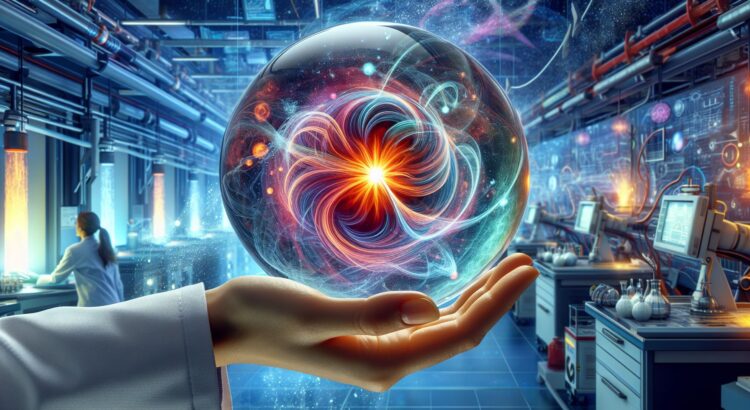
Hey tech enthusiasts, gear up because today I’m taking you on a thrilling ride through the cosmos! Well, almost. Strap in as we plunge into the realm of nuclear fusion, where humanity is oh-so-close to harnessing the power of a star right here on Earth. It feels like science fiction, but the fusion fantasy is inching towards reality, and it’s bound to shake up the energy world as we know it.
So, What’s the Big Deal About Nuclear Fusion?
Oh, just a little something called “unlimited clean energy.” While our planet scrambles for sustainable energy sources, nuclear fusion could be the golden ticket. Here’s a quick primer: unlike nuclear fission, which splits atoms apart (think CHERNOBYL!), fusion is the art of smooshing tiny atoms together to create a veritable fireworks show of energy. It’s what powers the sun, folks!
Fusion fuels come mainly from hydrogen isotopes, readily available elements that don’t require some Indiana Jones-esque quest to acquire. Tritium and deuterium, found in ordinary seawater, are the key players. Imagine a world where our two main ingredients are abundant and waste is barely a blip on the radar (none of that pesky radioactive stuff we’ve long associated with nuclear power). Sounds like a utopian dream, right? But there’s more.
The Science: Bringing the Stars to Earth
Here’s where it gets wild. Replicating the conditions inside a star on Earth? It’s got to be one of the most epic challenges ever taken on by scientists. To put it in perspective, the sun’s core needs temperatures of around 10 million degrees Celsius to get fusion going. But on Earth, thanks to limitations in pressure and density, we’re talking about 100 million degrees! Just a touch toastier.
To achieve these conditions, two main approaches are being developed: magnetic confinement and inertial confinement. The former uses magnetic fields to contain the plasma (the super-hot soup where fusion occurs), with the most famous being the “tokamak” design. An experimental tokamak, the ITER project in France, is our beacon of hope. It’s essentially a donut of doom for hydrogen isotopes, spin them around at insane speeds, jam them together, and you’re golden.
Inertial confinement, on the other hand, involves playing laser tag with pellets of fuel, compressing them with the power of a billion death stars. Slightly more sci-fi, but equally compelling!
The Hurdles: Why Isn’t My Home Fusion Reactor Here Yet?
Now, before you cast off your solar panels and start drafting plans for a fusion-powered jetpack, let’s talk obstacles. First off, achieving net-positive energy output, where more energy is generated than consumed, is the holy grail. We’ve seen breakthroughs claiming this milestone is within reach, but practical solutions always seem to be another decade away. The research is like a carrot on a stick, constantly tempting yet elusive.
Then there’s the cost. Fusion reactors are mammoth projects, huge feats of engineering demanding an equally massive budget. Enter governments and hefty investments, but let’s face it, convincing stakeholders to funnel truckloads of cash into an unproven tech is no small feat.
Fusion’s Bright Future: Why I’m Still Optimistic
Despite these hurdles, there’s no putting the fusion genie back in the bottle. With governments rallying behind the cause and private enterprises like Commonwealth Fusion Systems joining the race, the momentum is real. Advances in materials science, machine learning, and AI are pushing the boundaries, allowing us to overcome technical roadblocks faster than ever before. It’s like having Iron Man’s J.A.R.V.I.S. on our research team!
Fusion startups are popping up like mushrooms after rain, each promising some innovative solution. The enthusiasm reminds me of the early days of the internet revolution or the birth of personal computing. We’re witnessing history in the making, one plasma burst at a time.
What’s Next: The Fusion Countdown
So, what’s on the horizon? Optimists suggest viable fusion reactors could crank out commercial electricity within a couple of decades. I’d be lying if I said I wasn’t daydreaming of a world where our energy problems are zapped into oblivion, climate change is a ghost of crises past, and charging your smart device is as easy as catching a sunbeam in a jar.
Yes, there’s still a long road ahead, but with every small success, like when ITER switches on its first plasma in the late 2020s, we’re moving closer to that fusion-powered utopia. Who knows, in 50 years, what started as a wild scientific ambition could be as common as breakfast cereal.
Until then, keep your eyes on the stars, or rather, what we’ve brought down to Earth. In our quest to tame nuclear fusion, we might just transform our world in ways we can’t even imagine yet. Who wouldn’t want to give the sun a run for its money?
Remember, folks, though the challenges are daunting, the potential payoff is as vast as the universe itself. Let’s keep our fingers crossed, and maybe a few more toes for good measure. After all, the sky isn’t the limit, it’s only the beginning.