mzbwgcnpya

Space Travel: The Final Frontier for Tech Utopia

Hey everyone! Grab your helmets and get comfy because today we’re launching ourselves into the cosmos. If you’d asked me a decade ago if everyday folks would soon be zipping around in spacecrafts like 21st-century jetsetters, I’d have nodded enthusiastically while internally scoffing. Yet here we are in 2023, and space travel isn’t just for astronauts or sci-fi writers anymore. And let me tell ya, it’s exhilarating!

The Stark Reality of Space Travel

Alright, let’s set the boosters to realistic mode for a moment. Space travel is still in its infancy, kind of like watching a toddler take its first wobbly steps, except the toddler costs billions and occasionally bursts into flames (not quite as cute, eh?). Companies like SpaceX, Blue Origin, and Rocket Lab are racing to make space more accessible. Spoiler alert: things are getting pretty wild up there.

Remember when Elon Musk nonchalantly announced he’d be colonizing Mars? At first, it sounded like classic Musk theater, but SpaceX’s Starship has actually made some serious progress. We’re talking reusable rockets, sustainable propulsion systems, the whole nine yards. These rocket advances might not mean much for your next cross-country flight, but they completely change the game for reaching the stars.

The Commercial Colonization Debate

I’m gonna be honest, there’s a fair share of critics who roll their eyes at the idea of commercializing space travel. And honestly, I get it. The idea of turning the cosmos into the next capitalist playground brings to mind dystopian images of lunar real estate ads or asteroid mining stock options.

But here’s the thing: commercial space companies are driving innovation at speeds that make government agencies look like they’re on dial-up. Shuttle launches that once seemed prohibitively expensive are becoming increasingly routine and, dare I say, affordable (well, if you’re a billionaire, but still). Space travel for regular folks might not be here just yet, but it’s moving from impossible fantasy to expensive reality pretty damn quickly.

Meet the New Pioneers

If these aren’t household names already, let me introduce a few superheroes of the space-tech field. Jeff Bezos and his crew at Blue Origin are already on our radar with their New Shepard reusable suborbital vehicle, which I’m pretty sure doesn’t come with in-flight peanuts, but at least you get some gravity-defying thrills.

Then there’s the lesser-known but equally awesome crew at Rocket Lab, helmed by Peter Beck. They’ve been making waves with their compact yet powerful rockets. It’s like the little engine that could, except this engine is ridiculously advanced and, oh yeah, it goes to space. The private sector is really taking off, and these companies are leading the charge.

The Human Element: Living Beyond Earth

Now, let’s dig into what makes this all so exciting: humans actually living beyond Earth. The idea that our grandkids might consider “home” a place with a different planet name in their address? Mind-boggling, right?

But here’s where it gets interesting. Tech advances might create a scenario where living on other planets isn’t about merely surviving but actually thriving. We’re looking at potential colonies equipped with 3D-printed homes, hydroponic gardens, and sophisticated AI to keep everything from heating to life-support running smoothly. The scientific research possibilities are huge. Imagine the insights we could gain from studying long-term human health in microgravity. Mars could become an outpost for unprecedented studies, basically a lab on a planetary scale.

Out-of-this-World Challenges

Hang on, before we get too carried away, there are some serious challenges to this starry-eyed dream. The sheer logistical complexity of setting up sustainable life-support systems without a resupply mission mix-up (nobody needs a rocket-mail service delivering Tang instead of air filters!) is pretty daunting.

Radiation is another cosmic problem. Our blue planet conveniently shields us from most of it, but out there in space? Not so much. That’s why scientists are racing to develop materials and habitats that block cosmic rays, making sure any lunar dwelling isn’t a hotspot for space-induced health issues.

And then there’s the human element: the psychological strain of long-term isolation and confinement. Prepping people for voyages of immense psychological challenge means a whole new level of training. We’re talking about months or years away from Earth, from family, from everything familiar.

What’s Next: Pure Speculation (My Favorite Part)

But enough about the obstacles, let’s get into some fun speculation. Picture a world where your bucket list trip includes a selfie on the Sea of Tranquility or Christmas in a bustling Mars city. More than that, space travel could fuel our curiosity and unite us under a shared banner of exploration.

Eventually, space access might become as commonplace as the internet. And that’s when things get really interesting. Imagine international collaborations on interstellar projects, nations combining resources not for competition but for humanity’s advancement. Cheesy? Maybe. Optimistic? Absolutely.

So here’s my take: We’re living in an era where space really is our next frontier, full of uncharted opportunities and discoveries waiting to happen. It’s a pretty amazing reflection of human curiosity and our refusal to accept limits. The galaxy, it turns out, might not be the limit after all.

Keep your eyes on the stars, folks. We’re just getting started!

Stay cosmic,

[Your Tech Insider]
mqibljbemn

The AI Symphony: How Artificial Intelligence is Composing the Future of Creative Arts

Hey tech aficionados, gathering around the virtual campfire today for an electrifying topic that’s as futuristic as it is intriguing: artificial intelligence in the creative arts. Yes, the very concept of letting machines wield the paintbrush or strum a guitar sounds like a sci-fi wonderland we’re stepping into. It’s like handing Van Gogh’s brush to a hyper-smart calculator—will it recreate Starry Night or draw an uninspiring flowchart? Let’s jump into this fascinating symphony being composed by AI and see what all the fuss is about.

The Intersection of Bytes and Brushes

Artists or Artifacts?

In the past few years, AI has been staging a quiet takeover in the world of fine arts, slowly creeping into domains like painting, music, and literature. I remember queuing up in a virtual gallery during the 2020 lockdown days, sipping coffee as I browsed through AI-generated artworks that looked as profound as any human masterpiece. It left me both mesmerized and slightly anxious. Can these algorithms truly achieve what our expressive hearts can? Are we looking at artists or artifacts?

What’s exhilarating, and frankly terrifying, is how far we’ve come. Neural networks and deep learning algorithms are now churning out creations that can go head-to-head with human work. Companies like DeepArt and Artbreeder have become household names for their ability to generate striking visual pieces by crunching data and recognizing patterns beyond our wildest dreams.

Algorithmic Beats and Harmonies

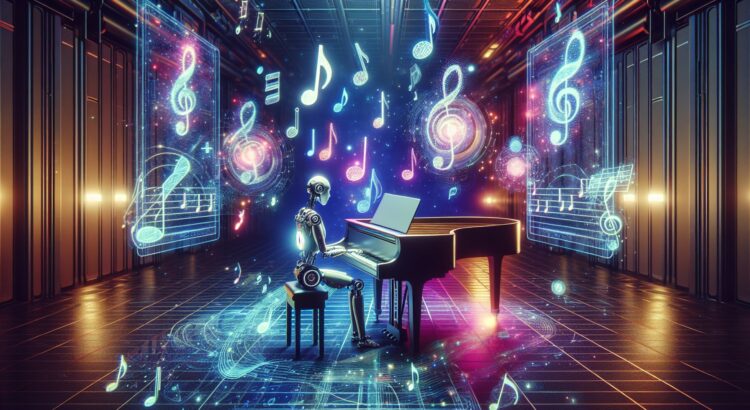
Music is yet another field where AI has been making its mark. Platforms like AIVA (Artificial Intelligence Virtual Artist) can now produce original compositions that aren’t just catchy but can evoke an emotional depth you’d usually associate with a seasoned composer. Think about the last epic score you heard in a movie; there’s a good chance that, soon, an algorithmic Beethoven might be behind it.

A few years back, I was at a music festival where one of the acts was a DJ who exclusively played AI-generated tunes. The crowd was rockin’—and it was a thought-provoking moment to realize that zero human hands had crafted those beats. It was as if the DJ was collaborating with code!

Pioneering Platforms and Visionaries

The Rise of Creative Coders

What I love about emerging technologies is the wealth of opportunity they present. AI in the creative arts is no exception. Innovators like Picasso and da Vinci are being reincarnated in the form of data scientists and computer engineers who now carry the torch of creativity. These modern-day Michelangelos are coding symphonies of kaleidoscopic possibilities.

Platforms sit right at the center of this revolution. RunwayML, OpenAI’s DALL-E, and Google’s Magenta project empower artists with AI tools that expand their creative horizons, allowing for hybrid forms of art that are neither purely human nor machine. It’s a marriage of the cerebral and artistic prowess of the human mind and computational genius.

When Machines Meet Muses

Let’s not forget the pioneers sparking this evolution. Personalities like Sophia Crespo have used AI to blend elements of art and science, producing artifacts that are surreal and organic, challenging, and enthralling. They’re exploring new territories where the muses reside alongside powerful processors.

I had a chance meeting with a tech artist last year, Sarah, who was using AI to create 3D sculptures. Watching her demonstrate how she could input different parameters and watch the computer sculpt a digital piece in real-time was like seeing magic unravel. Machines, muses, and magic, folks!

Potential Roadblocks on the Path of Progress

Creativity Without Emotion?

As we stand on this thrilling precipice, let’s anchor back to some tough questions. Can machines ever fundamentally “understand” art? Can they create without consciousness? These questions linger like shadows, dimming the glowing optimism just a bit.

After all, art has historically been an emotional catharsis for humanity, and AI lacks this very essence. For now, it relies on massive datasets and mimics patterns. The semantic depth, the layers of meaning behind a piece reducing its significance to a collection of metrics—it’s an ethical puzzle we must navigate thoughtfully.

Augmentation or Assimilation?

The question on everyone’s mind, including mine: Are we augmenting ourselves or being slowly replaced by silicon? Thoughtful use of AI can definitely complement human creativity, pushing our capabilities beyond their current limits. But let it run wild unchecked, and we might find ourselves in a homogenized artistic landscape—a strange future where originality becomes an algorithmic assembly line.

Wrapping: The Overture to an Age of Creativity

So folks, where do we go from here? Are we humming the prelude to a brave new world where AI becomes the demigod of the creative arts? Or is caution going to be the name of the game, balancing unrestrained innovation with humane consideration?

In this era of rapid technological change, one thing’s for certain—AI is here to stay, and it’s ready to tussle, tango, and create alongside us. It’s going to rewrite the narrative in ways we haven’t even imagined yet. And who knows, perhaps my next blog post will be co-authored by an AI scribe—let’s hope it’s as excited to explore the future as I am!

Here’s to symphonies yet unwritten and canvases yet untarnished, ready to absorb the colors of creativity, be it human or machine-dreamed. Cheers!

vrywvjzyas

Unlocking the Potential of AI in Creative Arts: A Journey Beyond Imagination

Hey there tech aficionados! Have you recently taken a moment to think about how far we’ve come with artificial intelligence? These days, AI isn’t just for number crunchers and data scientists. It’s making some seriously unexpected waves in areas we’d never have predicted just a few years back. Today, I want to chat with you all about what’s happening at the fascinating crossroads of AI and the creative arts. So, grab your favorite beverage, kick back, and let’s explore the future of artistic expression.

The AI & Art Renaissance

Ah, the arts—once the untouched dominion of human emotion and imagination. But hold onto your berets, folks, because AI is breaking into this domain with a swagger that’s simultaneously mind-blowing and slightly unnerving. Remember that scene in Ratatouille where Remy discovers flavor combinations he never thought possible? That’s AI entering our lofty world of creativity. But instead of blending herbs, it’s mixing pixels, sound waves, and plotlines.

AI art generators like DeepArt or OpenAI’s DALL-E have become the avant-garde artists of the digital age. They’re whipping up canvases that challenge traditional perspectives. In some instances, AI’s creations have sold at renowned art auctions for heaps—yes, heaps—of money. (Anyone got $432,500 handy?) While purists may cringe, art enthusiasts and techies like us find it’s a thrilling evolution. We are watching an artistic renaissance powered by algorithms. The artists? AI models trained on vast collections of human art from every era imaginable.

Music to Our Virtual Ears

Once upon a time, a generated beat might have been suitable only for elevator music. Sure, they had a certain robotic charm, but AI in music has evolved far beyond that. These days, you could find bots working alongside artists in top recording studios—no kidding!

AI music platforms such as Amper Music and AIVA are generating tracks that don’t just sound catchy; they’re moving and sophisticated. These programs analyze a staggering amount of music compositions to craft new, tailor-made soundtracks for anything from video games to indie films. Even masters like legendary composer Hans Zimmer have expressed awe at AI’s potential. Imagine a future where AI becomes the ultimate creative partner for composers, filling in the tedious gaps while artists focus on the intuitive strokes of genius. Mind-boggling, right?

The Literary Bots: AI Writing Companions

Now, picture this: a robot co-author who never takes control over the narrative thread but whispers fantastic character arcs and plot twists right in your ear. Yeah, it sounds straight outta Black Mirror, but it’s already happening with AI writing assistants like Sudowrite and Grammarly.

These digital companions are not about to replace authors (phew!) but are giving them superpowers: the ability to play with alternative styles, perspectives, and endless plot possibilities. AI is helping novelists get over writing blocks more effectively than a double-shot espresso. It’s an exciting time in literary history where AI doesn’t threaten to overshadow human genius but instead stands ready with an espresso shot for those moments when inspiration hits the skids.

Challenges and Complexity of AI Creating Art

While we’re riding this high tide of AI-generated creativity, we can’t ignore the flip side. As much as AI wows us with its artistic attempts, there are concerns. First off, there’s the question of originality. Can work composed by an AI truly be original or is it just a regurgitation of the data it has consumed? Artists spend lifetimes honing their craft; should an AI, with its knack for shortcuts, be celebrated as its own Picasso of pixels?

Moreover, we’re dealing with creativity and ethical concerns. How do we handle AI-contributed art with regards to intellectual property? Should a neural network get credit or its human partner? There’s a murky quagmire here that demands careful navigation because, much like Dr. Frankenstein, we need to know the responsibilities that come with our creation.

Peering Into the Future: AI’s Artistic Contribution

I’m inclined to think that AI, with its growing abilities, will keep pushing boundaries, expanding what we regard as art itself. If we’ve learned anything about technology, it’s that unpredictable innovation is par for the course. Ultimately, the most enticing part of AI in the creative arts is its relentless exploration in redefining our expectations, providing us platforms to better express raw human emotion and a canvas to experiment with.

The future of AI in creative arts echoes endless potential. AI may become the pencil and paintbrush, creating universes that challenge the canvas we’ve known. It’ll take some time to figure out where we go from here, but one thing’s for sure—our future looks creatively diverse and packed with potential that would give even Da Vinci something to marvel at.

That’s a wrap for today’s foray into the dizzying infinity of AI creativity. Are you excited, or maybe a tad apprehensive? Let’s dish it out in the comments. Till next time, keep those imaginations—and algorithms—buzzing!

ozwodlxyec

Nuclear Fusion: The Power of a Star in Our Hands

Hey tech enthusiasts, gear up because today I’m taking you on a thrilling ride through the cosmos! Well, almost. Strap in as we plunge into the realm of nuclear fusion, where humanity is oh-so-close to harnessing the power of a star right here on Earth. It feels like science fiction, but the fusion fantasy is inching towards reality, and it’s bound to shake up the energy world as we know it.

So, What’s the Big Deal About Nuclear Fusion?

Oh, just a little something called “unlimited clean energy.” While our planet scrambles for sustainable energy sources, nuclear fusion could be the golden ticket. Here’s a quick primer: unlike nuclear fission, which splits atoms apart (think CHERNOBYL!), fusion is the art of smooshing tiny atoms together to create a veritable fireworks show of energy. It’s what powers the sun, folks!

Fusion fuels come mainly from hydrogen isotopes, readily available elements that don’t require some Indiana Jones-esque quest to acquire. Tritium and deuterium, found in ordinary seawater, are the key players. Imagine a world where our two main ingredients are abundant and waste is barely a blip on the radar (none of that pesky radioactive stuff we’ve long associated with nuclear power). Sounds like a utopian dream, right? But there’s more.

The Science: Bringing the Stars to Earth

Here’s where it gets wild. Replicating the conditions inside a star on Earth? It’s got to be one of the most epic challenges ever taken on by scientists. To put it in perspective, the sun’s core needs temperatures of around 10 million degrees Celsius to get fusion going. But on Earth, thanks to limitations in pressure and density, we’re talking about 100 million degrees! Just a touch toastier.

To achieve these conditions, two main approaches are being developed: magnetic confinement and inertial confinement. The former uses magnetic fields to contain the plasma (the super-hot soup where fusion occurs), with the most famous being the “tokamak” design. An experimental tokamak, the ITER project in France, is our beacon of hope. It’s essentially a donut of doom for hydrogen isotopes, spin them around at insane speeds, jam them together, and you’re golden.

Inertial confinement, on the other hand, involves playing laser tag with pellets of fuel, compressing them with the power of a billion death stars. Slightly more sci-fi, but equally compelling!

The Hurdles: Why Isn’t My Home Fusion Reactor Here Yet?

Now, before you cast off your solar panels and start drafting plans for a fusion-powered jetpack, let’s talk obstacles. First off, achieving net-positive energy output, where more energy is generated than consumed, is the holy grail. We’ve seen breakthroughs claiming this milestone is within reach, but practical solutions always seem to be another decade away. The research is like a carrot on a stick, constantly tempting yet elusive.

Then there’s the cost. Fusion reactors are mammoth projects, huge feats of engineering demanding an equally massive budget. Enter governments and hefty investments, but let’s face it, convincing stakeholders to funnel truckloads of cash into an unproven tech is no small feat.

Fusion’s Bright Future: Why I’m Still Optimistic

Despite these hurdles, there’s no putting the fusion genie back in the bottle. With governments rallying behind the cause and private enterprises like Commonwealth Fusion Systems joining the race, the momentum is real. Advances in materials science, machine learning, and AI are pushing the boundaries, allowing us to overcome technical roadblocks faster than ever before. It’s like having Iron Man’s J.A.R.V.I.S. on our research team!

Fusion startups are popping up like mushrooms after rain, each promising some innovative solution. The enthusiasm reminds me of the early days of the internet revolution or the birth of personal computing. We’re witnessing history in the making, one plasma burst at a time.

What’s Next: The Fusion Countdown

So, what’s on the horizon? Optimists suggest viable fusion reactors could crank out commercial electricity within a couple of decades. I’d be lying if I said I wasn’t daydreaming of a world where our energy problems are zapped into oblivion, climate change is a ghost of crises past, and charging your smart device is as easy as catching a sunbeam in a jar.

Yes, there’s still a long road ahead, but with every small success, like when ITER switches on its first plasma in the late 2020s, we’re moving closer to that fusion-powered utopia. Who knows, in 50 years, what started as a wild scientific ambition could be as common as breakfast cereal.

Until then, keep your eyes on the stars, or rather, what we’ve brought down to Earth. In our quest to tame nuclear fusion, we might just transform our world in ways we can’t even imagine yet. Who wouldn’t want to give the sun a run for its money?

Remember, folks, though the challenges are daunting, the potential payoff is as vast as the universe itself. Let’s keep our fingers crossed, and maybe a few more toes for good measure. After all, the sky isn’t the limit, it’s only the beginning.

wrhfhndlsu

The Wave of AI in the Creative Arts: Painting, Poetry, and Beyond

Ah, the sweet symphony of technology and creativity—it’s a duet we’ve been excited about for decades, and now, it’s finally hitting the high notes. I’m always fascinated by how artificial intelligence is elbowing its way into every nook and cranny of our lives, but recently, it’s the AI’s foray into the creative arts that’s got me all kinds of excited. Imagine: machines that can paint a portrait, compose a sonnet, or even design an entire fashion line. It’s like the world’s coolest art show, and everyone’s invited!

When AI Paints the Town Red

Let’s start with the paintbrush, one of humanity’s oldest tools for storytelling. AI has recently become quite the painter, and it’s doing more than just staying inside the lines. You might remember when an AI-generated piece called “Portrait of Edmond de Belamy” sold for a staggering $432,500 at auction in 2018. Since then, AI painters have come a long way. These aren’t just copies of existing works but original pieces created by algorithms trained to understand texture, color, and style.

In my humble opinion, the real excitement is seeing what AI artists can create in collaboration with humans. Google DeepDream opened doors a while back, but programs like DALL-E 2 are now taking it up several notches. Artists use these tools not to replace their creativity but to expand it, inspire new directions, and explore uncharted territory. It’s like having a digital muse with endless patience and infinite imagination.

From Verses to Versatility: AI Poets

Switching gears to poetry, AI has been dipping its toes, or perhaps its processors, into the world of verse. I remember testing out GPT-3 to see if it could handle a haiku, and let’s just say, it wasn’t half bad! But the new models tackle sonnets and free verse with a creativity that’s starting to give the Romantics a run for their money.

Sure, right now, the poets among us might be safe. After all, there’s something uniquely human about raw emotion. However, AI poets have started to employ emotional intelligence, picking up cues from vast libraries of literature to create beautifully poignant prose. Poets who can turn data into prose, there’s an art form for the Fourth Industrial Revolution, if there ever was one.

Fashioning the Future

Let’s not forget the fashion industry, where AI is strutting its stuff on virtual catwalks. Fashion houses use AI to predict trends, optimize supply chains, and even design clothing. Imagine making a custom-fitted jacket in minutes with AI assistance or trying on a dozen outfits without leaving your bedroom, thanks to augmented reality and machine learning.

I see a future where AI doesn’t just spot trends but sets them. Digital garments created by AI might start influencing how physical clothes are made and worn. It’s personalized fashion for the masses, thanks to data-driven analyses that can adjust to cultural shifts and personal preferences faster than you can say “haute couture.”

A Brush of Ethics and an Eye for the Future

Of course, it wouldn’t be a proper tech conversation without jumping into the ethical pool. As with any powerful tech, AI in creative arts raises questions, like “Who owns an AI-generated piece?” and “What happens to human artists?” While there’s no definitive answer, this growing field pushes us to rethink the very nature of creativity and ownership.

I wouldn’t be surprised if future creative teams are made up of both humans and AIs, working in harmony to push the boundaries of art. This could mean more opportunities, not fewer, for artists willing to embrace AI as a tool, just like a new brush or musical instrument.

Wrapping Up: The Art of the Possible

Honestly, I’m as giddy as a kid in a candy store watching AI remix what it means to be creative. Far from being the robots from dystopian fears, these AI artists are more like curious apprentices, learning from us and presenting new visions.

AI in the creative arts isn’t just about creating pretty pictures or catchy tunes. It’s reshaping how we view art, technology, and human ingenuity. We’re not just spectators but participants in this wonderful and weird process. Let’s grab a paintbrush, or, heck, a data set, and create something magical together. After all, art isn’t just meant to be seen but to be made by every one of us.